
Arrest Warrants in Elmore County
An arrest warrant is signed court process that lets officers take a named person into custody. Under Alabama Rule of Criminal Procedure 3.1, a judge or magistrate reviews a complaint and the facts behind it. The court must find probable cause that an offense happened and that the accused committed it. That call belongs to the court alone. A police report can start the process, but the report itself is not a signed Elmore County arrest warrant. Elmore's official warrant instructions describe how it works locally: a deputy completes an Incident/Offense Report and delivers it to the Circuit Clerk when seeking a warrant against someone. No public form lets a citizen issue one online. The complaint route can end in a summons or an arrest warrant. After a grand jury indicts, a separate indictment route takes over.
Elmore Arrest Report-to-Clerk Path
Elmore County moves a warrant across several offices. A deputy writes down the reported facts. The report then travels to the Elmore County Circuit Clerk, whose office runs Criminal and Warrants divisions. From there a judge or magistrate makes the legal call on issuance. Knowing that chain helps when you check status, because the Sheriff may serve the process while the issuing court alone decides whether it stands and stays active.
- Law enforcement prepares the Incident/Offense Report and supporting complaint information.
- The material reaches the Circuit Clerk for the correct criminal or warrants route.
- A judge or magistrate determines whether probable cause supports process and whether Rule 3.1 calls for a summons or arrest warrant.
- Law enforcement receives executable process if the court issues an arrest warrant.
For records routing in Elmore County, use the Circuit Clerk's official division page. Treat it as a contact point, not a public all-warrant search.
What an Elmore County Arrest Warrant Contains
A solid Elmore County arrest warrant record ties a person and a charge to one court file. Check the court and division first. Circuit Criminal handles felonies. District Criminal handles misdemeanors and preliminary felony proceedings, and municipal courts keep their own city matters. A matching name without the right case identifier proves nothing.
| Case or process number | The exact court identifier, shown here only as a format example: CC-CASE-NUMBER. |
|---|---|
| Named subject | The defendant name and identifying details held by the verified office. |
| Charge or offense | The alleged offense and any Alabama Code or municipal ordinance reference. |
| Issuing authority | The judge, magistrate, and Circuit, District, or municipal court tied to the process. |
| Bond or release terms | The amount, type, or special condition set by the court, if release is available. |
| Status dates | Issue, service, return, recall, satisfaction, hearing, or release dates recorded in the file. |
Rule 3.2 Elmore Felony Process
Alabama Rule of Criminal Procedure 3.2 covers arrest process after an indictment, a path distinct from the complaint review under Rule 3.1. An indictment-based warrant runs through Elmore County Circuit Court, which handles felony prosecutions. District Court may first hold a preliminary felony hearing.
- Complaint warrant
- A judge or magistrate finds probable cause from a complaint and supporting facts.
- Indictment warrant
- Arrest process that follows a grand jury indictment through Circuit Court.
- Return
- The record that process was served or returned to the court. It does not mean dismissal.
- Recall or quash
- A court action withdrawing or ending process. Only the issuing authority can confirm it.
How Elmore County Arrest Warrants Are Served
The Elmore County Sheriff's Office lists patrol, investigations, court services, support, and jail among its services, and those units may execute state court process. City police handle process tied to municipal cases. The county posts no constable or city-marshal matrix, so ask the issuing court or the Sheriff which agency holds a specific Elmore County arrest warrant and may execute it. After an arrest, custody and court review are separate stages. The Sheriff's jail information describes a facility that runs around the clock, though it lists no public walk-in warrant surrender schedule. Rule 4.3 governs initial appearance and release procedure after arrest. It promises no release, no set bond, and no particular ruling.
Elmore Warrant Lists Have Limits
The Sheriff's Most Wanted interface is a curated public-safety program, not the full Elmore County arrest warrant file. A person's absence from it rules out nothing about recent, sealed, municipal, or federal process. The inmate roster shows custody, not every pending warrant.
Key point: Confirm an Elmore County arrest warrant with the issuing court, even when a public list returns no match.
Alabama's paid Just One Look docket service can help you locate state court case information. It is no guaranteed all-warrant index. An Elmore County clerk can confirm whether an entry is current, recalled, served, or tied to another division.
Arrest Warrant vs Summons vs Bench Warrant
Each document demands a different response. Rule 3.1 lets a court issue a summons instead of an arrest warrant in suitable complaint cases, directing the accused to appear without an initial arrest. An Elmore County bench warrant usually follows a missed court duty or noncompliance. Ignore a summons, and the court may issue arrest process later.
| Feature | Arrest Warrant | Summons | Bench Warrant |
|---|---|---|---|
| What it orders | Custody and court processing | Appearance on the stated date | Custody after a missed duty |
| Basis | Complaint probable cause or indictment | Charge handled first by notice | Failure to appear or comply |
| Authority | Judge or magistrate | Court process under the rule | The court handling the missed duty |
| Response | Confirm, seek counsel, plan appearance | Appear as directed | Ask the issuing court about recall or appearance |
Confirm Elmore Arrest Warrant Authority
Start with the document or case entry itself. Pull the issuing court, case number, process type, charge, and any bond notation. Circuit Criminal, District Criminal, and municipal records do not swap. The Elmore judiciary directory lists separate criminal and traffic routes, and the Sheriff's main line sits on the official contact page.
Elmore County Circuit Clerk
Use Criminal or Warrants division routing for state court status, the operative order, and recall questions.
Elmore County Sheriff's Office
(334) 567-5546
Use for law-enforcement routing, execution, jail, and custody questions.
Never send sensitive identifying facts through an unverified service. Share them only with the official Elmore County office that can confirm your own or a family member's matter.
What to Do If There's a Warrant for You
Call the issuing court first. That is where an Elmore County arrest warrant gets confirmed or cleared. Ask whether it is active. Ask what charge and case it belongs to, what bond has been set, and whether the judge requires surrender, an initial appearance, or another step. The clerk can give status and routing, but not legal advice. A licensed Alabama attorney can assess a motion to recall or quash, arrange a controlled appearance, and explain bond or probation consequences. Phone ahead before a voluntary surrender. Confirm the correct site, identification, booking steps, bond type and amount, and any special condition. Posting bond is a release process, not a dismissal. A motion counts only if the judge grants it. Get the written order, receipt, bond release, or updated docket entry. Then recheck status with the court.
Important: Speak with counsel before appearing. An active Elmore County arrest warrant can be executed during ordinary law-enforcement contact.
Elmore County court costs vary by case. Elmore's court-cost page lists bond-related lines, but the court or jail must confirm current amounts and whether they apply.
Elmore Criminal Divisions Route Records
The Elmore County judiciary directory lists the clerk routes. Circuit Criminal, District Criminal, Traffic, and Warrants each stand apart.
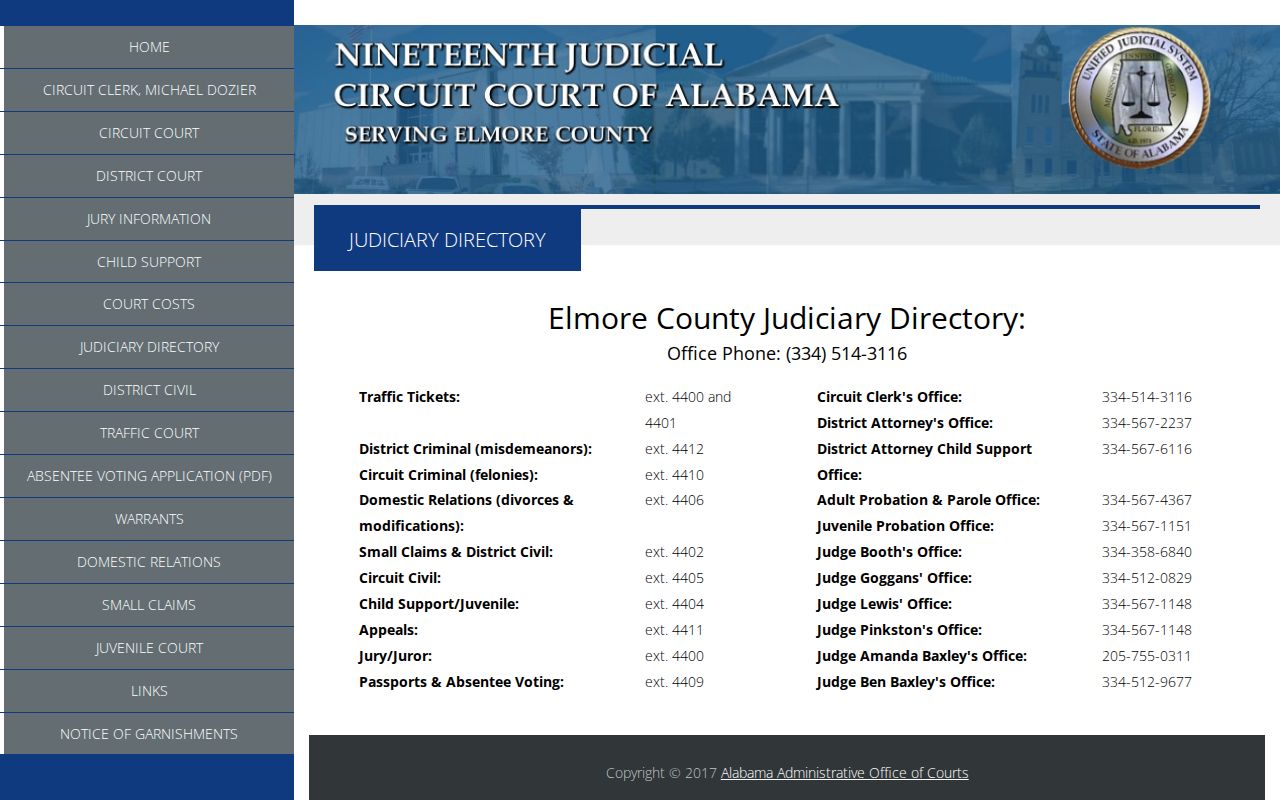
That Elmore County division structure is why one broad warrant search can miss the answer. A felony indictment sits with Circuit Criminal. A misdemeanor or preliminary felony matter may sit in District Criminal. City cases can stay with the municipal court. Give the clerk the exact case number and process type when you have it, and ask which division owns the operative order. If the clerk says no active warrant, ask further. Ask whether the process was recalled, quashed, served, satisfied, sealed, or simply not indexed. Write down the clerk's direction. Elmore County publishes no universal expiration date for an arrest warrant. Age alone never proves that process ended.